


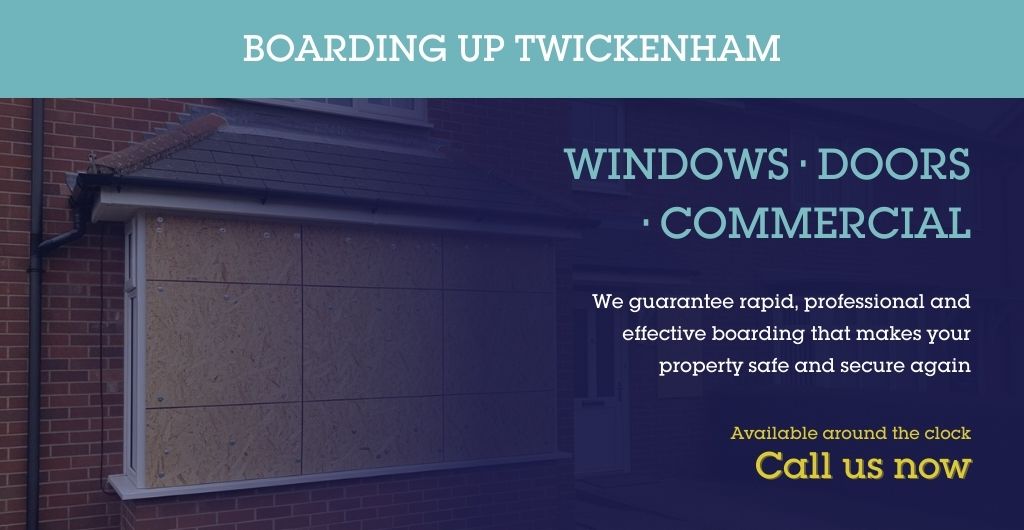
Insurance Support for Boarding Up in Twickenham
When you need insurance support for boarding up in Twickenham, you are already dealing with enough stress – whether it is a break-in, vandalism, storm, fire, flood or an accident. We help you board up and secure your property quickly and provide clear, insurance‑ready paperwork so you can move your claim forward without extra hassle.
With over 10 years’ experience providing emergency boarding up across Twickenham and the wider TW and SW postcode areas, we understand exactly what most insurers expect after damage to windows, doors, roofs or shopfronts.
Need urgent help and paperwork for your insurer?
Call 020 3772 7375 any time, day or night.
How We Help with Insurance Claims
We are not loss adjusters or legal advisers, but we work with insurance claims every day. Our job is to:
- Make your property safe and secure with non-destructive securing wherever possible.
- Document what we find and what we do in a way that helps you explain events to your insurer.
- Provide simple, insurance-friendly paperwork you can upload or email to your insurance company.
Typical situations where clients need both emergency boarding up and insurance support include:
- Post-burglary boarding up in Twickenham – damaged doors, forced locks, smashed windows.
- Vandalism boarding – cracked shopfronts, graffiti damage to glass, smashed panels.
- Storm damage boarding – blown-out windows, lifted roof lights, damaged skylights.
- Fire damage boarding – broken glazing, forced access points after firefighting.
- Flood or accident damage – vehicle impacts, structural cracks around openings.
If you are unsure what to do first after damage, our team can talk you through the immediate steps while we dispatch a boarding-up specialist.
Step-by-Step: Simple Insurance Claim Support
1. Make the Area Safe and Secure
Your safety comes first. After you call us, we will:
- Ask a few quick questions about the incident and damage.
- Check whether the emergency services (police, fire, ambulance) are involved or still on site.
- Arrange a fast boarding up visit to your home, shop, office or other property anywhere in Twickenham or the wider TW/SW area.
On arrival we will:
- Assess risks such as loose glass, exposed nails, unstable frames or unsafe access.
- Clear or cordon off dangerous debris where it is safe to do so.
- Board up windows, doors, shopfronts or roof openings using a non-destructive approach wherever possible.
If you want more detail on our methods, see our dedicated boarding up services in Twickenham overview.
2. Take Time-Stamped Photos of Damage and Work
We always encourage clients to take their own photos for their records. In addition, our technician will normally:
- Take clear, time‑stamped photos of the damaged areas before we start work (where safe to do so).
- Photograph the completed boarding up so your insurer can see the make-safe securing.
If you have already started a claim or the insurer has specific requests (for example, close-ups of locks or frames), let us know when you call.
3. Provide an Itemised Invoice
Once the job is complete, we issue an itemised invoice that clearly sets out:
- Property address and your contact details.
- Date and time of attendance.
- Reason for attendance – e.g. “post‑burglary boarding up”, “storm damage boarding” or “vandalism repair to shopfront glass”.
- Materials used – e.g. OSB boarding, plywood thickness, anti‑tamper fixings, temporary steel doors or security screens if applicable.
- Labour and access considerations (e.g. roof boarding at height, restricted access).
This level of detail helps insurers understand what was required to make the property safe and why.
You can learn more about cost factors on our boarding up prices page.
4. Brief Work Statement (on Request)
Where helpful, we can add a short work statement on the invoice or issue a simple supporting note describing:
- What we found on arrival (e.g. “front door frame split around the lock, glass in door shattered, debris on internal hallway”).
- Immediate risks identified (e.g. “exposed sharp glass edges, unsecured property front, open access to street”).
- What we did to secure the property (e.g. “installed 18mm OSB boarding internally with anti‑tamper fixings; fitted temporary secure door at entrance”).
This is written in plain language so both you and your insurer can understand it easily.
5. You Submit the Claim to Your Insurer
You remain in full control of your claim. In almost all cases, you will be the one to:
- Notify your insurer of the incident.
- Provide any police reference number (see below).
- Upload or email our invoice, photos and any additional notes we provide.
- Ask your insurer about next steps, such as permanent glazing or repairs.
If you need help explaining the work we carried out when speaking to your insurer, we are happy to clarify our part.
What Paperwork We Provide
To support your claim, we can typically provide:
- Itemised invoice – clearly showing boarding up materials and labour.
- Time-stamped photos – of damage and finished work, where practical and safe.
- Brief work description or statement – especially useful for post-burglary or vandalism claims.
- Company details confirming:
- We are an experienced local boarding up contractor covering TW and SW postcodes.
- We hold relevant public liability insurance.
- Our boarding-up technicians are DBS-checked.
This is the kind of insurance-ready paperwork most UK home, landlord and commercial policies expect when you claim for emergency securing.
Please note: we are not legal advisers and we do not decide whether your claim is accepted – that is solely the insurer’s decision.
For more on specific events, see:
Keeping Police and Incident Details
In many cases – especially burglary, attempted break-ins or vandalism – your insurer will expect you to have:
- Reported the incident to the police (101 or 999 in an emergency).
- Obtained a crime reference number or incident number.
- Passed that reference to your insurer when starting the claim.
We always recommend:
- Keeping a note of the time and date of the incident (or when you discovered it).
- Recording how you found the damage (e.g. “arrived to open shop at 07:30 and found front glass smashed”).
- Storing your crime reference number somewhere safe, together with our invoice.
Your insurer may cross‑check this information when processing your claim.
Non-Destructive Securing and Insurance Expectations
Most insurers want your property to be:
- Secured quickly – to prevent further loss, theft, water ingress or injury.
- Secured sensibly – using methods appropriate to the building and situation.
- Documented clearly – with invoices and photos where possible.
We work to a non-destructive securing principle wherever we can:
- Boarding is fixed to frames or reveals in a way that avoids additional damage where possible.
- We use appropriate thickness of plywood or OSB boarding for strength and insurance satisfaction (commonly 11–18mm or more, depending on opening size and risk).
- Anti‑tamper fixings are used externally so boards cannot easily be removed from the outside.
- For doors that cannot be safely secured, we may install temporary steel doors with robust locks.
Rare exceptions to non‑destructive methods might include:
- Severe structural damage, such as frames that have split or partially collapsed.
- Fire‑damaged areas where materials are too weak or brittle to hold standard fixings.
- Situations where emergency services have already caused significant forced entry.
In those cases, we still work carefully to minimise any further damage, documenting what we find and what we have to do for safety.
For more about the general process, you can also see what boarding up is and how it works.
Domestic, Commercial and Vacant Property Claims
We support a wide range of policy types:
- Residential insurance claims – owner‑occupied homes, flats and HMOs.
- Residential boarding up in Twickenham for burglary, smashed windows, storm and accidental damage.
- Commercial boarding up – shops, offices, restaurants, pubs, warehouses and more.
- Landlord and estate agent claims – where tenants have caused damage or properties are between lets.
- Vacant property boarding – medium‑term securing of empty or void properties using Sitex‑style steel security screens and temporary steel doors where required.
We regularly assist facilities managers, landlords and property managers with insurer paperwork across multiple properties within the TW and SW postcode areas.
What Happens Next
Once your property is safe and boarded up:
- We walk you through the work completed and answer any immediate questions.
- We issue your itemised invoice and any agreed supporting notes (paper or digital).
- You forward these details to your insurer along with your:
- Policy number
- Claim reference
- Police/crime reference number (if relevant)
If you need follow‑on work such as glazing or a more secure medium‑term solution for a vacant property, we can liaise with your chosen contractors or give you guidance on next steps.
To explore specific services that may form part of your claim, you can look at:
- Window boarding in Twickenham
- Door boarding up
- Shopfront boarding for commercial properties
- Roof & skylight boarding for storm damage
If you are comparing options or insurers have asked you to obtain quotes, our boarding up prices guide explains what typically affects cost.
FAQs – Insurance and Boarding Up
Do I have to pay you, or do you bill my insurer directly?
In most cases, you pay us directly for the emergency boarding up, then claim the cost back from your insurer as part of your overall claim. We provide all the paperwork you need to do this.
If your insurer has told you they will pay us directly, please let us know their instructions when you call so we can follow the correct process.
Is boarding up covered by insurance?
Many home, landlord and commercial policies do cover emergency boarding up and securing, but every policy is different.
We cannot guarantee cover, but we:
- Provide clear, itemised invoices.
- Describe the incident type and work done in plain language.
You then send this to your insurer so they can decide under the terms of your policy.
What do I need to give my insurer after a break-in?
Typically you will need:
- Your policy number.
- A crime reference number from the police (for burglary or vandalism).
- Our itemised invoice and any photos or statements provided.
Your insurer may also ask for your own photos or a short written description of what happened. For detailed guidance on securing your property after a break-in, see post-burglary boarding up in Twickenham.
Can you help if my insurer needs extra information?
Yes. If your insurer has follow‑up questions about the work we carried out (for example, board thickness or why we installed a temporary steel door), we can usually clarify this by phone or email. We cannot advise them on claim outcomes, but we are happy to explain our methods and materials.
Do I need to get approval from my insurer before calling you?
If it is unsafe or the property is insecure, most insurers expect you to act immediately to reduce risk and prevent further damage. In emergencies, call us first to make the property safe, then notify your insurer as soon as possible afterwards.
If you are not sure, you can check your policy wording or call your insurer’s helpline, but do not leave a property insecure while waiting for written authorisation unless they explicitly instruct you to.
Need help now with boarding up and insurance paperwork?
Call 020 3772 7375 or Email us for fast, professional support across Twickenham and the wider TW and SW postcode areas.
Helpful links
